


Office in UAE (United Arab Emirates)


Choosing a property in UAE (United Arab Emirates) for your request
- 🔸 Reliable new buildings and ready-made apartments
- 🔸 Without commissions and intermediaries
- 🔸 Online display and remote transaction

International Real Estate Consultant
Need help choosing a property?
Leave a request and our manager will contact you.
International Real Estate Consultant

Weather in UAE (United Arab Emirates)
For Sale office in UAE (United Arab Emirates)
Offices in Dubai

 1
1
 10
10

 1
127
1
127
 1
91
1
91
Didnt find the right facility?
Leave a request - we will handle the selection and send the best offers in a short period of time



Irina Nikolaeva
Sales Director, HataMatata
Office in UAE (United Arab Emirates)
Choosing a property in UAE (United Arab Emirates) for your request
- 🔸 Reliable new buildings and ready-made apartments
- 🔸 Without commissions and intermediaries
- 🔸 Online display and remote transaction
International Real Estate Consultant
Need help choosing a property?
Leave a request and our manager will contact you.
International Real Estate Consultant
Individual selection offices in UAE (United Arab Emirates)
Save time — for free we will select objects for your budget and goals
🇦🇪 UAE office market overview: ownership rules, free zone differences, and key locations
The United Arab Emirates remains one of the most dynamic markets for commercial real estate in the Middle East, with sustained demand for high-quality office space from multinationals, regional businesses and investors. Major business hubs such as Dubai, Abu Dhabi, and Sharjah combine modern infrastructure, global connectivity and sector clusters — finance in Dubai International Financial Centre, energy in Abu Dhabi’s ADGM and industrial logistics near Jebel Ali and Khalifa Industrial Zone — that shape where companies prefer to locate. Office formats range from flexible coworking suites and Grade A tower floors to light-industrial business parks and free-zone offices, with typical sizes starting at 30–50 m² (small suites) up to entire floor plates of 1,000 m²+ in flagship towers. For buyers and investors evaluating Office in UAE (United Arab Emirates), understanding local transport nodes, proximity to airports, metro access and tenant mix is essential to forecast occupancy, rental yield and long-term value.
💶 How much Office costs in UAE (United Arab Emirates)
Office prices in the UAE vary significantly by city, district, building class and whether the property is in a free zone or mainland. Central Dubai business addresses command the highest capital values, while secondary districts and emerging nodes offer lower entry prices and higher capitalization prospects. Pricing tiers are driven by location, building amenities, and leasing maturity.
Office price ranges and typical sizes:
- Dubai Downtown / DIFC / Business Bay: $6,000–$12,000 per m² for Grade A; typical small suites $150,000–$500,000; whole floors $2M+.
- Dubai Marina / Jumeirah Lake Towers / Media City: $3,000–$7,000 per m²; suites from $100,000.
- Abu Dhabi Corniche / ADGM / Al Maryah Island: $3,500–$8,500 per m²; island towers priced at premium.
- Sharjah / Ras Al Khaimah / Ajman: $800–$2,500 per m² for business parks and small offices.
- Free zone plug-and-play offices (e.g., Dubai Multi Commodities Centre, JAFZA): $1,200–$5,500 per m² depending on fit-out and tenure.
Office market dynamics show steady leasing demand for flexible formats and Grade A space in core business districts, with secondary locations seeing capital appreciation as infrastructure projects and metro extensions improve connectivity. Investors targeting Investment office in UAE (United Arab Emirates) should model expected rental yield for office in UAE (United Arab Emirates)—typically 5–8% gross in prime districts and 7–10% in well-located secondary zones.
🎯 Which region of UAE (United Arab Emirates) to choose for buying office
Choosing the right region depends on tenant profile, intended use and exit strategy. Financial services, law firms and corporate headquarters gravitate to DIFC, ADGM and Dubai International Financial Centre locations because of regulatory ecosystems and prestige. Tech, media and creative industries prefer Dubai Media City, Dubai Internet City and twofour54 in Abu Dhabi for clustering and talent access.
Key regions, transport and advantages:
- DIFC / Downtown Dubai: proximity to Dubai Metro, Dubai International Airport, premium corporate services, higher rents but strong liquidity.
- Business Bay / Dubai World Trade Centre: excellent road links, new metro stations, demand from regional HQs and professional services.
- Jebel Ali Free Zone (JAFZA) / Khalifa Industrial Zone (KIZAD): logistics-oriented, critical for import/export businesses and light manufacturing.
- Al Maryah Island / ADGM (Abu Dhabi): strong for energy firms, sovereign investments and private equity offices.
- Sharjah Airport International Free Zone (SAIF) / Ajman Free Zone: cost-efficient options for SMEs and traders.
Choosing a region should align with expected rental demand, tenant profile and accessibility to airports such as Dubai International (DXB), Al Maktoum (DWC), and Abu Dhabi International (AUH), which directly influence occupancy and corporate relocations.
🏙️ How UAE (United Arab Emirates) geography, climate and infrastructure shape office demand
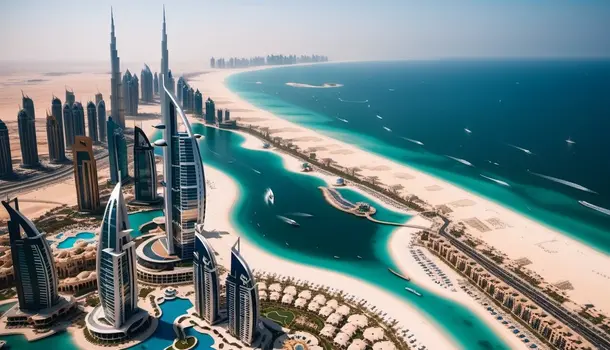
The UAE’s compact urban centers, coastal geography and desert climate influence office siting and building design. Coastal hubs such as Dubai and Abu Dhabi concentrate towers along waterfronts and business corridors, creating high-density office clusters that benefit from cooling infrastructure and integrated public transport. Harbors, free zones and logistics nodes near Jebel Ali and Khalifa Port enable trade-linked office demand.
Infrastructure anchors driving office demand include:
- Metro lines in Dubai (Red, Green) and planned network extensions that increase values along transit corridors.
- Major airports (DXB, DWC, AUH) providing global connectivity that multinational tenants prioritize.
- Ports and free zones (Jebel Ali, KIZAD, JAFZA) supporting trade, logistics and industrial office needs.
Climate considerations lead developers to deliver high-efficiency glass, central cooling systems and covered pedestrian links, which are increasingly required by corporate tenants. Businesses also factor in workforce mobility, schools, hospitals (e.g., Cleveland Clinic Abu Dhabi, Mediclinic) and retail amenities when selecting office locations, which in turn shapes demand patterns and long-term asset liquidity.
📈 Economy and investment climate in UAE (United Arab Emirates) and their effect on office market
The UAE’s diversified economy, sovereign investment vehicles and business-friendly regulations have created a predictable environment for commercial property investors. Oil is no longer the sole driver; finance, logistics, tourism, technology and renewable energy sectors support office absorption across emirates. Corporate tax frameworks, free zone incentives and double taxation treaties enhance international appeal.
Economic and investment factors shaping offices:
- Open trade and FDI policies attract multinational headquarters and regional offices, boosting demand for Grade A space.
- Tourism and business travel volumes sustain demand for serviced offices near airports and exhibition centers like DWTC.
- Tax regime advantages: absence of federal property tax and corporate tax benefits in specific zones increase net yields, though municipal fees and VAT apply.
These macro conditions improve liquidity for Investment office in UAE (United Arab Emirates) and help maintain competitive ROI on office in UAE (United Arab Emirates) compared with regional peers, with institutional investors actively acquiring prime floors and mixed-use office towers.
🏗️ Leading developers and projects offering office in UAE (United Arab Emirates)
Major UAE developers have established landmark office assets and mixed-use precincts that attract global tenants and investors. These developers combine international standards, long-term asset management and pre-leasing strategies that support investor confidence.
Notable developers and flagship projects:
- Emaar Properties — Downtown Dubai towers, mixed-use podium offices and DIFC-adjacent developments.
- DAMAC Properties — Business Bay and Dubai Marina commercial floors integrated with luxury residential.
- Aldar Properties — Al Maryah Island and Reem Island office projects in Abu Dhabi.
- Nakheel — Business districts in Dubai, including Palm Jumeirah commercial podiums.
- DP World / JAFZA / AD Ports — logistics-linked business parks and office campuses in Jebel Ali and Khalifa Port.
Developers often offer turnkey office suites, managed offices and build-to-suit corporate campuses; investors evaluating these projects should analyze developer track record, completion timelines and tenant pre-commitments.
🧾 Mortgage and installment conditions for foreigners in UAE (United Arab Emirates)
Foreign buyers have access to mortgage financing and developer installment plans, though terms differ between mainland and free-zone properties and among emirate-based lenders. Local and international banks provide mortgage products that cater to corporate buyers, HNWI and individual foreign investors.
Typical mortgage and installment conditions:
- Mortgage UAE (United Arab Emirates) for foreigners: interest rates anchored to EIBOR or bank base rates plus margin; average effective rates vary but competitive offers exist.
- Down payments: commonly 20–40% for non-residents depending on property type and bank underwriting.
- Loan tenors: up to 25 years for salaried buyers; commercial loans often shorter, between 5–15 years.
- Developer installment plans: ranging from 30–60 months interest-free on off-plan projects from major developers like Emaar, Aldar, and Nakheel.
Banks require proof of income, credit history, KYC documents, and often higher serviceability thresholds for foreign buyers. For those seeking an office in UAE (United Arab Emirates) with mortgage or an office in UAE (United Arab Emirates) with installment plan, pre-approval and alignment with developer payment schedules streamline acquisition.
🔍 Legal process to buy office in UAE (United Arab Emirates)
Legal transparency and a formal registration framework make office transactions straightforward when procedures are followed. The Legal process to buy office in UAE (United Arab Emirates) includes due diligence, contract negotiation, escrow arrangements for off-plan deals and title registration at emirate land departments.
Step-by-step purchase milestones:
- Reservation and Offer: sign a Memorandum of Understanding and pay reservation deposit; review master community rules and free zone operating regulations.
- Sales and Purchase Agreement: notarized contract outlining payment schedule, handover conditions and service charge obligations.
- Registration and Title Transfer: transfer recorded at Dubai Land Department, Abu Dhabi Department of Municipalities and Transport or equivalent; mortgage registration if financing is used.
- Handover and Service Charges: final payment on handover, payment of registration fees and setup of utility accounts and Ejari or tenancy registrations as required.
Legal checks should include verifying developer escrow compliance for off-plan assets, confirming freehold status, reviewing building completion certificates and validating existing tenant leases if buying an income-producing asset. Timelines vary but an on-plan purchase can span 12–48 months to completion while ready assets typically close within 4–8 weeks after due diligence.
⚖️ Legal ownership, taxes and residence rules for office in UAE (United Arab Emirates)
Ownership regimes differ between freehold areas, free zones and mainland jurisdictions, affecting ownership rights, leasing rules and tax treatment. Foreign ownership is permitted in designated freehold areas; free zones offer benefits including 100% foreign ownership and simplified business licensing.
Key legal and tax considerations:
- Property taxes: there is no federal property tax; municipal rates, registration fees and VAT on commercial leases and certain services apply, summarized under Property taxes in UAE (United Arab Emirates) for foreigners.
- Rental regulations: tenancy laws vary by emirate and free zone; commercial tenancy often governed by contract with arbitration clauses and DIFC/ADGM legal frameworks for certain zones.
- Residence and visas: purchasing an office does not automatically grant residency in most cases, though certain investments and company formations can enable visa sponsorship; references such as Residence permit through office investment in UAE (United Arab Emirates) and Buy office as a foreigner in UAE (United Arab Emirates) relate to business activity-based visa pathways rather than property titles.
Purchase does not confer citizenship; UAE citizenship is not available through property investment. Investors seeking long-term residency options should review corporate structuring, free zone license types and investor visa thresholds which, when met, can support residence permit applications such as targeted investor visas.
🎯 Which purposes buying office in UAE (United Arab Emirates) is suitable for
Buying an office can serve multiple strategic aims: establishing a regional headquarters, securing rental income, relocating staff, or holding a premium asset for capital appreciation. Matching the purpose to location and format is essential for performance.
Purpose-driven location and property types:
- Corporate HQ and relocation: DIFC, ADGM, Business Bay — full floors or multi-tenanted fitted offices for professional services and finance.
- Startups and tech firms: Dubai Internet City, Dubai Silicon Oasis, twofour54 Abu Dhabi — flexible co-working or plug-and-play offices with networking ecosystems.
- Logistics and trade companies: JAFZA, KIZAD, Khalifa Port — business parks and campus-style offices adjacent to warehousing.
- Investment and rental: central Grade A in DIFC, Downtown, Al Maryah Island for stable tenants and predictable rental yield for office in UAE (United Arab Emirates).
- Small firms and SMEs: free zones (DMCC, DSO, RAKEZ) offering lower setup costs and simplified licensing.
Buying an office as a vehicle for a Golden visa through office investment in UAE (United Arab Emirates) requires specific investment structures and thresholds; investors should consult immigration criteria and corporate visa pathways to align property purchase with residency planning.
Market prospects across the UAE show continued demand for high-quality office stock, especially flexible and sustainable workspaces close to transport hubs. As new infrastructure projects and regulatory incentives evolve, investors who focus on well-located assets with professional management are likely to capture stable rental streams and appreciate capital values, supporting solid ROI on office in UAE (United Arab Emirates) and attractive long-term portfolio diversification.
Frequently Asked Questions
Yes. In the UAE (United Arab Emirates) foreigners can buy commercial units in designated freehold zones with 100% ownership; mainland purchases and company setup rules vary by emirate and activity. Expect registration and legal checks to take several weeks; always verify local land department rules and licensing timelines.
Office pricing varies widely across the UAE (United Arab Emirates). Prime office rents typically range about AED 120–360 per sq ft per year; average gross yields across major centres are roughly 5–8%; citywide vacancy commonly sits in the 15–30% range. Purchase prices depend on location and quality and reflect these rent/yield dynamics.
Buying an office can support residency routes in the UAE (United Arab Emirates) but rules differ: property investment schemes often require high minimum values (commonly multimillion-AED thresholds) and may favor residential assets; company formation or sponsoring employees also yields residence visas. Processing typically takes weeks to a few months; citizenship is not granted via purchase.
The UAE (United Arab Emirates) has no personal income tax; VAT at 5% applies to most commercial leases and services. A federal corporate tax applies to taxable business profits above a set threshold at a headline rate of about 9%. Expect transfer/registration fees of around 2–4% plus agency and community charges; timeline: budgeting for upfront transaction costs is essential.
The UAE (United Arab Emirates) can preserve capital via stable currency (pegged to USD), rental income and diversified economy. Typical gross yields of 5–8% help income preservation; liquidity and values vary by emirate. A medium-term hold (5–10 years) is commonly recommended to ride cycles and protect capital against short-term volatility.
Dubai and Abu Dhabi lead the UAE (United Arab Emirates) for office demand, liquidity and institutional tenants; Sharjah and emerging emirates offer lower entry prices and yield upside. Demand concentration in major hubs means quicker leasing and exits; investment horizons of several years capture the best appreciation and rental stability.
Steps: shortlist, due diligence, sign sale agreement, pay deposit, register transfer with the emirate land department, settle fees and taxes. In the UAE (United Arab Emirates) a straightforward purchase usually completes in 4–12 weeks; off‑plan or company-linked deals can take longer. Include time for licensing if you’ll operate a business onsite.
Yes. UAE (United Arab Emirates) banks and lenders offer commercial mortgages to residents and non‑residents. Typical loan-to-value for commercial property ranges roughly 50–70%; down payments commonly 30–50% for foreign buyers. Approval timelines vary from a few weeks to several months depending on borrower profile and documentation.
Liquidity is strongest in Dubai and Abu Dhabi; selling or re-leasing in those emirates can take months rather than years. Typical sale cycles are often 3–12 months depending on market and price; leasing can be faster for well-located, fitted units. Plan exits over a medium-term window (6–18 months) to allow marketing and negotiation.
Key risks in the UAE (United Arab Emirates): oversupply, tenant defaults, regulatory or tax changes, and location-specific vacancy. Mitigate by choosing prime locations, securing strong leases, diversifying tenant mix, underwriting conservative yields, and allowing a 3–7 year horizon to absorb market cycles.
Properties by Region
Properties by Country
- Real estate in Bulgaria (11408)
- Real estate in Montenegro (5360)
- Real estate in Indonesia (2423)
- Real estate in Spain (2289)
- Real estate in Portugal (1975)
- Real estate in Italy (1897)
- Real estate in Turkey (1699)
- Real estate in Cyprus (1590)
- Real estate in Thailand (1565)
- Real estate in Croatia (1431)
- Real estate in Greece (1082)
- Real estate in USA (1013)
- Real estate in France (1006)
- Real estate in Georgia (519)
- Real estate in Serbia (328)
- Real estate in Slovenia (123)
- Real estate in Egypt (23)
UAE Developers
Don't know where to start buying a property in UAE (United Arab Emirates)?
Leave a request and receive free advice on prices, taxes, residence permits and the real estate market. in UAE (United Arab Emirates).

Maria Guven
Head of Direct Sales Department
+90-507-705-8082