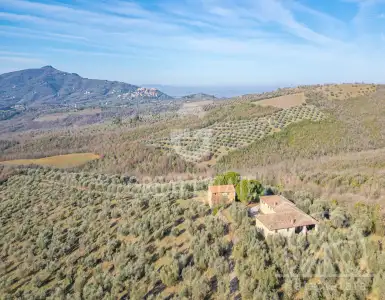
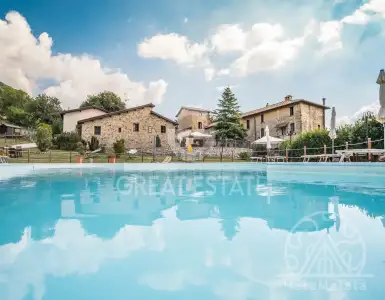
Nestled in the tranquility of the Umbrian hills, this charming historic village, developed around a 16th-century military tower and meticulously restored in 2016, now stands as a prestigious, fully operational hospitality estate. Its approximately 1,200 sqm of interior space unfolds within a private 4-hectare estate, surrounded by manicured gardens and centuries-old olive groves.
The complex comprises six independent residences: four interconnected houses in the central body and two cottages, totaling 15 bedrooms, all equipped with air conditioning, and 15 bathrooms. Each unit features a private entrance, fully equipped kitchen, bright living areas, and private outdoor spaces. The interiors are captivating, as the conservation-focused restoration has enhanced the typical elements of traditional Umbrian farmhouses, such as antique terracotta floors, restored wooden beam ceilings, stone walls, and original representative fireplaces. Every room harmoniously blends historical ambiance with contemporary comfort, creating a perfect balance of hospitality, functionality, and charm.
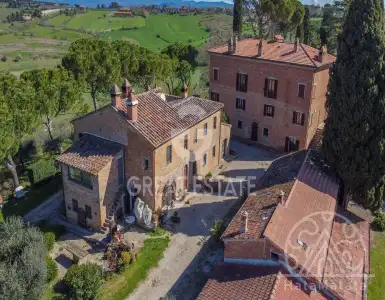
The village layout retains its medieval imprint intact: arched loggias, terraces overlooking the valley, stone courtyards, and ancient staircases create a suggestive and theatrical atmosphere, ideal for exclusive hospitality experiences.
The jewel of the property is the Santa Lucia chapel, dating back to 1707, impeccably preserved and restored, currently used for intimate ceremonies and weddings.
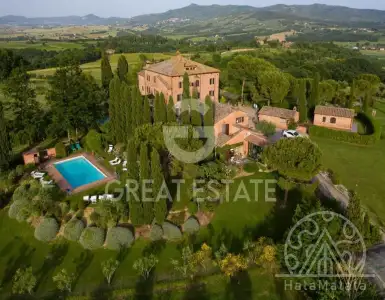
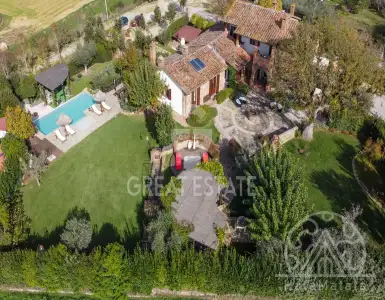
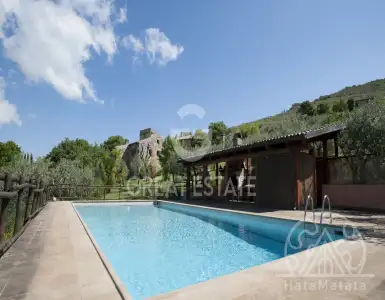
Completing the estate is an enchanting garden leading to a panoramic swimming pool with solarium, barbecue and relaxation areas immersed in greenery, a tennis court to be restored, a fitness room, and a spacious carport parking area equipped with 10 kW photovoltaic panels. The entire complex is accessible via a private road with an automated gate, leading to the characteristic internal square paved with terracotta.
Currently, the village operates successfully as a luxury boutique retreat, offering short-term rentals and exclusive stays with high profitability.
How can I get a residence permit by buying property in Italy?
In Italy a residence permit is typically issued based on a minimum investment threshold. Applications are reviewed within 30–60 days in Perugia; you will need a passport, proof of funds, and the ownership documents. Hatamatata helps prepare and submit the paperwork.
Is a mortgage available for non-residents in Italy?
Banks in Italy finance 50–70% of the property value for non-residents with rates of 3–5% for 20–30 years. A life insurance policy and a 30–40% down payment are usually required. Terms and programs vary by city and bank.
What taxes and fees apply when buying in Italy?
Expected expenses: transfer tax 0–15%, registration 0.5–2%, notary 0.5–1.5%, agent commission 0–3%. In total 2–20% on top of the purchase price. Exact rates depend on region, property type and programs.
How is the title checked in Italy?
A title search at the land registry of Italy takes 10–15 business days. You receive ownership, encumbrance and tax clearance certificates. Documents are translated and reviewed by a lawyer before signing.
Can I rent out property after purchase in Italy?
Yes. Rental income tax is 5–25% depending on the regime. In Perugia short-term tourist rentals typically yield 5–8% per year. Municipal permission and income registration are usually required.
Is a property inspection recommended before purchase?
Yes. An inspection costs about 0.5–1% of the price (1 758 399 $) and covers structure, utilities and legal status. Hatamatata arranges a qualified engineer with an EN/RU report.
How long does the purchase process take in Italy?
A typical transaction runs 30–90 days, averaging 45 in Perugia: due diligence (10–15 days), notarization (5–7 days), registration (10–14 days), residence permit (30–60 days, if needed).
A property nestled among olive trees with breathtaking views over one of the most beautiful villages in Italy. The main building of the estate extends over a total surfac...
The property unfolds like a charming private hamlet, composed of a historic farmhouse, two independent villas, and a separate guesthouse, enriched by a series of outbuild...
Charming 18th century residence including a master villa, a farmhouse, and an annex in a panoramic position on the border between Umbria and Tuscany. The three-level vill...
This marvellous property was rebuilt from a ruin in the late 1980s, maintaining the characteristics of a typical local farmhouse. Later, more restoration efforts and impr...
The structure dates back to the end of the 19th century and was then renovated according to the typical local traditions, keeping the original features intact. The main f...
The property belongs to the Italian film director Michelangelo Antonioni and includes a main building that develops on a living area of approximately 470 sqm, divided ove...


 1 758 399 $
 1 736 419 $
 1 736 419 $
 1 736 419 $
 1 846 319 $
 1 846 319 $