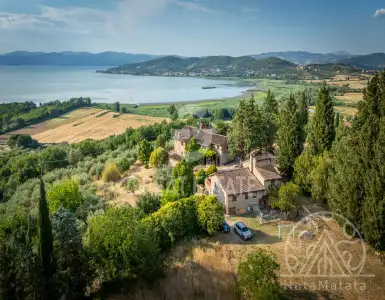
The farmhouse is made up of two levels. The ground floor, formerly used as an old stable, has been transformed into a beautiful living space consisting of a living room with wood stove, wood fireplace, wooden beams and terracotta floors, a very bright veranda with large glass windows, a dining room, a spacious kitchen with island, a study used as a bedroom, a service bathroom, a technical room, a pantry, a bathroom with shower, and a laundry room. The second floor is accessed via an internal English-style staircase, or from the outside with a restored ancient staircase, the bedroom with a larger four-poster bed (once used as a kitchen with a large fireplace), three bedrooms with en suite-bathrooms, a double bedroom, and two bathrooms with shower. During the restoration, the original wooden beams and terracotta tiles were kept. The garden with centuries-old olive trees and other ornamental plants, completely fenced, a swimming pool with a salt and chlorine system, a masonry oven with bbq, a shelter in which a photovoltaic system has been installed that develops 5.5kw.
How can I get a residence permit by buying property in Italy?
In Italy a residence permit is typically issued based on a minimum investment threshold. Applications are reviewed within 30–60 days in Perugia; you will need a passport, proof of funds, and the ownership documents. Hatamatata helps prepare and submit the paperwork.
Is a mortgage available for non-residents in Italy?
Banks in Italy finance 50–70% of the property value for non-residents with rates of 3–5% for 20–30 years. A life insurance policy and a 30–40% down payment are usually required. Terms and programs vary by city and bank.
What taxes and fees apply when buying in Italy?
Expected expenses: transfer tax 0–15%, registration 0.5–2%, notary 0.5–1.5%, agent commission 0–3%. In total 2–20% on top of the purchase price. Exact rates depend on region, property type and programs.
How is the title checked in Italy?
A title search at the land registry of Italy takes 10–15 business days. You receive ownership, encumbrance and tax clearance certificates. Documents are translated and reviewed by a lawyer before signing.
Can I rent out property after purchase in Italy?
Yes. Rental income tax is 5–25% depending on the regime. In Perugia short-term tourist rentals typically yield 5–8% per year. Municipal permission and income registration are usually required.
Is a property inspection recommended before purchase?
Yes. An inspection costs about 0.5–1% of the price (870 105 $) and covers structure, utilities and legal status. Hatamatata arranges a qualified engineer with an EN/RU report.
How long does the purchase process take in Italy?
A typical transaction runs 30–90 days, averaging 45 in Perugia: due diligence (10–15 days), notarization (5–7 days), registration (10–14 days), residence permit (30–60 days, if needed).
The stunning Dimora dei Sogni is located in the most mystical part of Umbria, between the unspoiled hills that separate Umbertide from Gubbio, in a high and very panorami...
Derived from an ancient countryside farmhouse just steps from the center of Corciano and fully renovated last year with high-quality materials, Alba Di Corciano is being...
This property awaits you in the green heart of Umbria, in the province of Perugia, a short distance from Lake Trasimeno. A unique place, a true natural paradise overflowi...
Exclusive farmhouse, in Umbria in Città di Castello - "Genga" is the name of a toponym of an elegant country house from which it literally arose from a centuries-old anci...
The main house, arranged over two levels, welcomes you on the ground floor with a spacious living area with fireplace, distinguished by three large arches, a kitchen, one...
In Città della Pieve, in a panoramic position, stands this recently built, highly energy efficient farmhouse spread over 3 levels. On the ground floor there is a large op...


 Mountain View view 859 091 $
 837 063 $
 826 049 $
 914 161 $
 925 175 $
 936 189 $