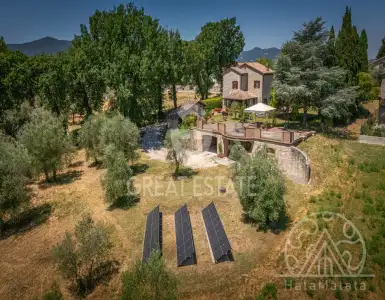
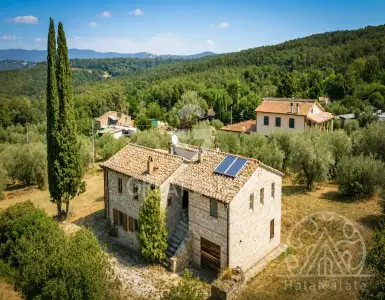
On the picturesque road leading to the renowned Franciscan convent of “Scarzuola” with its celebrated “Ideal City” designed by architect Tomaso Buzzi, stands a typical Umbrian stone farmhouse set on a total land area exceeding 8,500 sqm. The property comprises buildings with a total surface of approximately 450 sqm, including three residential units, a former stable with high potential, and unfinished rooms that could be converted into additional usable space.
The main farmhouse features a first apartment on the ground floor with an independent entrance and an external porch, consisting of a living area, kitchen, master bedroom and a bathroom with a shower.
The second apartment, also with independent access on the ground floor, includes a living/tavern area and a staircase leading to the first floor, where two bedrooms and a bathroom are located.
An external staircase with a characteristic loggia leads to the principal master apartment, offering a large and spacious living area with a fireplace and built-in kitchen corner, a study/bedroom, two bedrooms and two bathrooms with showers, as well as a hallway with a potential connecting door to the rest of the house. In fact, the apartments could partially or entirely be interconnected, creating a grand residence.
The property is in excellent condition in the habitable areas, featuring typical elements such as wooden beams, terracotta flooring, and stone details that evoke the charm of the Umbrian countryside. On the ground floor, there is ample space in the former stable, which requires internal finishing, ideal for converting into an atmospheric tavern, woodshed, and various storage rooms, including an ancient wood-fired oven and technical rooms with water reserves.
The fenced garden includes a lawn and a variety of plants, complemented by a quaint, rounded swimming pool reminiscent of a typical pond. The land, including the courtyard, spans around 8,000 sqm, featuring a large garden, 17 productive olive trees yielding excellent oil, several fruit trees, as well as oaks and native plants typical of the Mediterranean scrubland. There is also space for an orchard or the cultivation of medicinal herbs.
Thanks to its three apartments, the property is perfect not only as a principal residence but also for hospitality purposes, accommodating holiday guests or friends.
Enchanting views of the countryside and the village of Montegiove with its dominant castle complete this exceptional offering.
It will be possible to purchase an adjacent plot with a ruin suitable for building a guesthouse or annexe for an additional €50,000.
How can I get a residence permit by buying property in Italy?
In Italy a residence permit is typically issued based on a minimum investment threshold. Applications are reviewed within 30–60 days in Terni; you will need a passport, proof of funds, and the ownership documents. Hatamatata helps prepare and submit the paperwork.
Is a mortgage available for non-residents in Italy?
Banks in Italy finance 50–70% of the property value for non-residents with rates of 3–5% for 20–30 years. A life insurance policy and a 30–40% down payment are usually required. Terms and programs vary by city and bank.
What taxes and fees apply when buying in Italy?
Expected expenses: transfer tax 0–15%, registration 0.5–2%, notary 0.5–1.5%, agent commission 0–3%. In total 2–20% on top of the purchase price. Exact rates depend on region, property type and programs.
How is the title checked in Italy?
A title search at the land registry of Italy takes 10–15 business days. You receive ownership, encumbrance and tax clearance certificates. Documents are translated and reviewed by a lawyer before signing.
Can I rent out property after purchase in Italy?
Yes. Rental income tax is 5–25% depending on the regime. In Terni short-term tourist rentals typically yield 5–8% per year. Municipal permission and income registration are usually required.
Is a property inspection recommended before purchase?
Yes. An inspection costs about 0.5–1% of the price (603 567 $) and covers structure, utilities and legal status. Hatamatata arranges a qualified engineer with an EN/RU report.
How long does the purchase process take in Italy?
A typical transaction runs 30–90 days, averaging 45 in Terni: due diligence (10–15 days), notarization (5–7 days), registration (10–14 days), residence permit (30–60 days, if needed).
Il Casale Rotello – Rustic Elegance in the Heart of Umbria Nestled in the enchanting Umbrian countryside, just a few kilometers from historic Orvieto and conveniently acc...
The property is presented as a restored country house, located in the hamlet of Ripalvella, in the surrounding hills of the UNESCO Biosphere of the San Venanzo Volcanolog...
Privacy, views and contemporary comfort define Casale Pian Dell'Ara, a stone farmhouse restored in 2023, set in the hills of Avigliano Umbro, in the heart of the Todi are...
Borgo San Nicolò is a rarely available original complex, to be completely restored, with authentic rural flavour. It will show new glory thank to a rebuilding and restora...
Casale Mary Rose is arranged over 3 levels for a total of approximately 239 sqm. Access is from the road level, where a spacious parking area is located. On this same lev...
Nestled in the peace and quiet of the Umbrian hills, in a charming natural setting in the area of Giove, this characterful stone farmhouse represents the ideal retreat fo...


 600 262 $
 594 755 $
 638 811 $
 649 825 $
 539 685 $